
Parenting Life & Scheduling Reality Time Management Tips For Busy Parents

Most days it can feel like your family calendar is running you, not the other way around. Work, school, meals, homework, sports, music, playdates, camps, screen time, sleep. It is a lot, and the pressure to “do it all” makes many parents feel like they are always behind.
This guide walks through a realistic way to manage a busy family schedule so you can balance work and home life with less scrambling and more breathing room.

Step 1: Decide What Really Matters In Your Week
The first shift is to stop asking “How do I fit everything in” and start asking “What actually deserves space.” This reduces constant guilt and makes every later decision easier.
Before planning the week, list the few things that truly define a good week for your family. This might include being on time to work and school, one relaxed family meal, enough sleep, or one activity that lights your child up.
Once that list exists, everything else becomes optional. When conflicts appear, you know what gets protected and what can move. This transforms time management tips for parents from vague advice into clear filters you can actually use.
Step 2: Build A Simple Weekly Framework Before You Add Details
Busy schedules feel chaotic when every day is different and nothing is mapped out. A weekly framework gives you a repeatable pattern so you do not start from scratch every Sunday night.
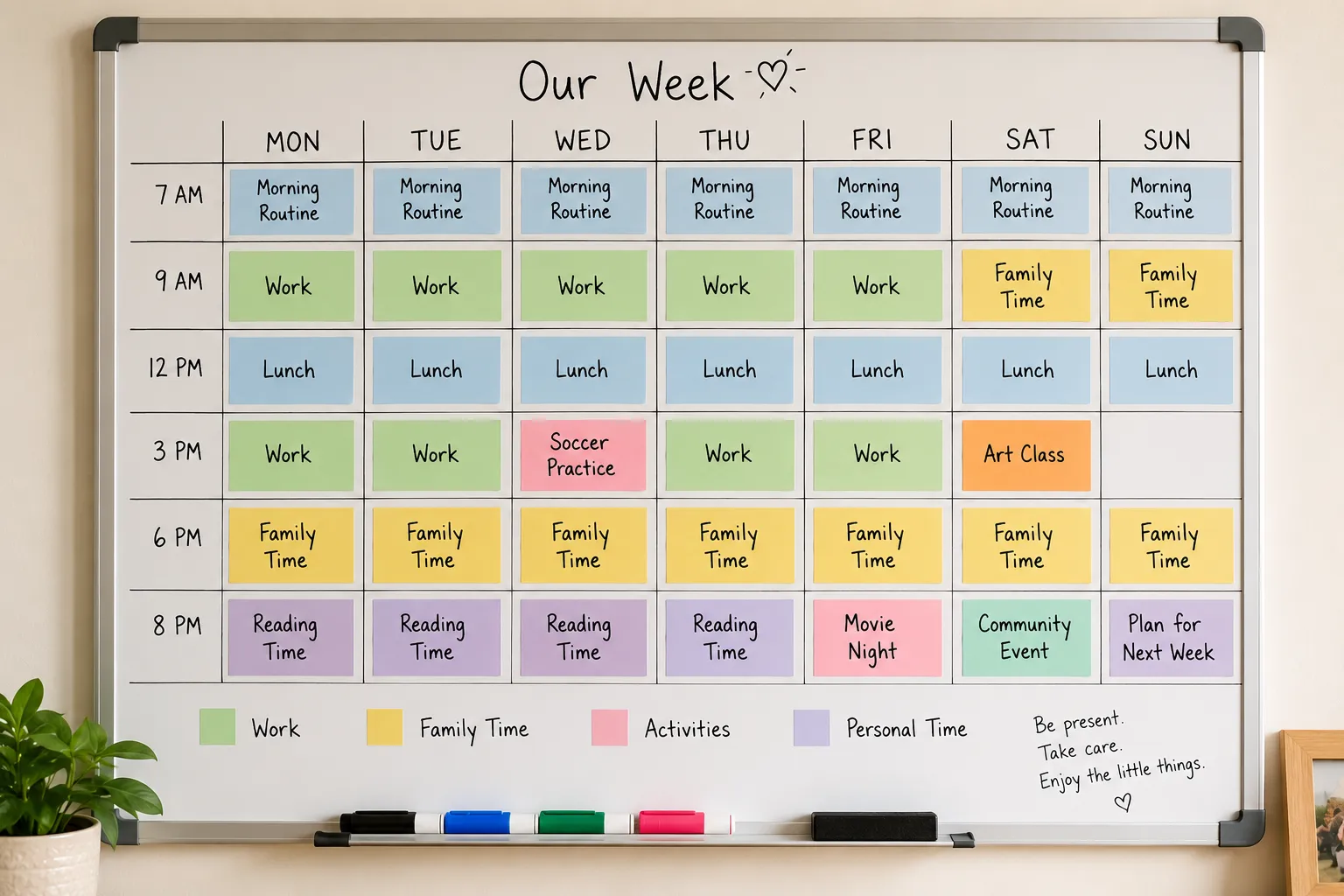
Create a rough template of your week that answers only three questions.
- When is non negotiable work time
- When is protected family time
- When is flexible time for errands and kids activities
You can sketch this on paper, in a digital calendar, or in a shared app. The goal is not a perfect color coded system, just a visible structure that shows where time actually exists. Parents balancing work and family responsibilities can then slot tasks into the right kind of time instead of squeezing everything into every open minute.
Once this simple map exists, you can quickly see if you are asking more of a day than it can reasonably hold. That awareness is what keeps balancing work and family life from becoming an endless series of rushed transitions.
Step 3: Use The Right Tools To Organize Kids Activities
Once the framework is clear, you can decide where camps, classes, sports, and after school programs fit, and which ones do not. This is where many parents get overwhelmed, because information about programs is scattered across websites, flyers, and social media groups.
Time management tips for busy moms and dads become much more practical when activity details live in one place. A platform like BeAKid lets you search local programs, filter by age and interest, compare schedules, and see availability without jumping between tabs. That means you can check an activity against your weekly framework while you are planning, instead of discovering conflicts after you have already registered.
When you find an activity that fits your child and your calendar, you can book directly on the platform, handle payments, and save program details where you will not lose them. This turns the question “how to manage a busy family schedule” into a concrete workflow rather than a constant hunt for links, PDFs, and email threads.
Step 4: Protect Your Energy To Avoid Burnout And Overscheduling
Even a beautifully planned schedule can lead to burnout if there is no recovery time. Parental burnout from overscheduling often comes from saying yes to one more thing again and again until there is no margin left for rest [FACT_CHECK_NEEDED].
A simple rule can prevent this. For every activity you add, ask what you are subtracting. If you cannot name something you will remove, the new commitment probably does not fit your current season of life.
Balancing work and home life is not just about fitting obligations together. It is about leaving enough space for small resets like an early bedtime, a short walk, or ten minutes of quiet after the kids are asleep. These pockets of rest are what help you stay patient in traffic, present at bedtime, and focused during meetings.
Consistent routines also help kids feel secure, which can reduce resistance and power struggles around transitions. That makes mornings, pickups, and activity drop offs smoother, which in turn lightens your load.
Step 5: Adjust For Special Scheduling Challenges
Certain family situations make time management even more demanding. A single parent who handles everything, a household with several children, or a parent caring for a toddler and a newborn faces layers of logistics that most generic tips ignore. Each case benefits from a specific strategy that is used only in that context.
Time Management Strategies For Single Parents
Single parents often carry the full load of research, transportation, and communication. Time management strategies for single parents work best when they reduce repeated work.
Batch similar tasks together. Set one short block each week to review school updates, activity emails, and upcoming events in one sitting, and enter everything into a single calendar. This prevents information from hiding in old messages and lowers the chance of missed deadlines or double bookings.
Sharing that calendar with trusted adults who occasionally help with pickups can also ease last minute stress without requiring constant texts or calls each time a detail changes.
Scheduling Tips For Parents Of Multiple Children
Scheduling tips for parents of multiple children need to address overlapping needs without repeating the same coordination steps for every child. A simple approach is to give each child a default activity “slot” during the week, such as one afternoon for enrichment or sports, and one weekend window for a fun option.
When you discover activities on BeAKid, filter by age groups and time blocks that match those default slots. That way you are choosing from programs that already fit the pattern you created, instead of scrambling to fit entirely new time blocks into the week. This keeps balancing work and family life schedule choices from becoming a puzzle you have to re solve every month.
Managing Schedules With A Toddler And A Newborn
Parents caring for a toddler and a newborn juggle naps, feeds, and unpredictable nights. In this season, time management tips for busy parents need to focus on simplicity rather than maximizing activities.
Choose only very low friction outings, like a nearby music class or parent child playgroup that welcomes siblings and has flexible arrival time. Aim for one predictable anchor outing each week for the toddler, not a packed calendar.
Any activity you join should respect your current limits. Programs that are close to home, have straightforward registration, and clear expectations will feel much more manageable when you are already short on sleep and attention.
"When my second baby was born, I kept trying to maintain the same busy schedule we'd always had, and it quickly became exhausting. The biggest change was giving myself permission to do less. Instead of planning something every day, I chose one simple outing each week for my toddler and let the rest of our routine happen at home. That small adjustment took so much pressure off, and everyone—including me—was happier." — Parent of two young children
FAQ
How do you balance your work and family life when everything feels urgent
Treat work time, family time, and flexible time as three separate categories in your calendar, and protect them differently. Once you see how many hours truly belong to each group, you can decline or reschedule new requests that would push into the wrong category, instead of trying to respond to everything as if it is equally urgent.
What are realistic time management tips for working parents who have long hours
Plan around your true energy peaks and valleys rather than only the clock. If evenings are your lowest energy point, simplify dinners, limit evening commitments, and shift any planning or paperwork to a short morning or weekend window when you can think clearly. This makes the hours you do have with your kids feel more intentional, even if they are limited.
How can I prevent parental burnout from overscheduling kids activities
Set a hard limit on the number of weekly activities per child and per family evening, and review it each season. Use that limit as a rule before signing up for anything else. If something new sounds appealing, ask which existing commitment it would replace, instead of stacking it on top.
What is the first step if my current schedule already feels out of control
Start with one week. Write down everything that actually happens for seven days, including commutes, screen time, and late night tasks. At the end of the week, highlight what felt meaningful and what felt draining. This snapshot gives you concrete information to decide what to drop, what to keep, and where a new program or support could genuinely help.
Family life will probably never be perfectly calm or perfectly organized, and it does not need to be. A clear sense of what matters, a simple weekly framework, and the right tools for choosing kids activities can turn a chaotic calendar into a schedule that mostly works for you instead of against you.
When you are ready to fill the open spaces in that framework with camps, classes, or after school options that fit your reality, you can explore local programs on BeAKid, compare schedules, and enroll in a few clicks. One small change in how you plan today can make the next season of family life feel a lot more livable.